A quick shot of the dummy hedge created at today's Belmont Wood Fest looking away from the event towards the wood.
I was in a bit of a corner but not cut off from the main event being between some stick makers and Kent Woodland Employment, some of whose machinery can be seen on the right. I did get a good number of interested visitors and some possible leads for work, although some people did want me to build one of these in their garden!
Showcasing some of the competition, group and communal hedgelaying projects I have been involved in. Laying a hedge re-rejuvenates it and creates valuable habitat for many species of wildlife.
Saturday, 10 October 2015
Thursday, 1 October 2015
What did you do on your holidays?
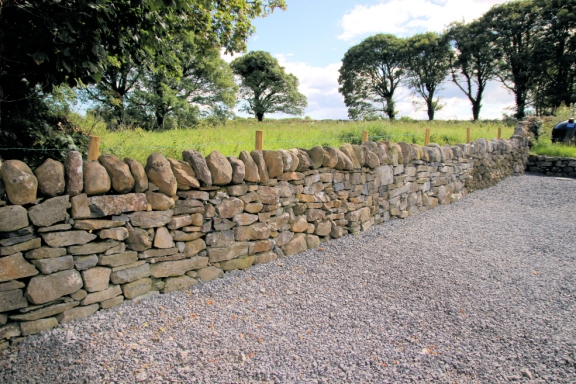
Over the summer I finally finished the wall I have be re-constructing at our cottage in Co Mayo, Ireland.
This is my first attempt at a dry stone wall and whilst it may not last 100 years I hope it will see me out.
The original was probably built over a hundred years ago but has most likely been partly rebuilt during that period, as the section furthest from the road was of an old and unusual style known locally as feidín, where the base and lower part of the wall is built with small stones, often with large uprights at regular intervals, with larger stones used for the upper part. My understanding is that this particular style is only found in walls in parts of Galway and Mayo, but oddly also in Galloway in Scotland. Several local people were able to name this style but no one had a translation from the Gaelic or a reason why it was used in this area - more research needed.
This is the feidín section nearest the camera and I was able to retain the lower part, having removed a large tree stump from the middle of the wall. You can also see the remains of the ivy which had completely covered the wall and dislodged most of the upper stones. Additional stone came from some recently demolished sheds that were of a similar age to our cottage.
This is my first attempt at a dry stone wall and whilst it may not last 100 years I hope it will see me out.
Monday, 6 July 2015
Before, After and Regrowth
Paid a quick visit this morning to the hedge at Avery Hill that we laid earlier this year. This was not an easy hedge to work, having been planted more as an amenity line of shrubs and trees than a hedge - far too many Field Maples and ornamentals and too few Hawthornes. Some of plants had been 'pruned' in the past and others, mainly Field Maple, allowed to grow into medium sized trees.
All three photos are taken from approximately the same place and first up is the hedge as it was in November 2014 before laying. Tall Field Maples, some Hawthorne, shrubby Holly, dense areas of Dog Rose and some Hazel nearest the camera. There were also a number of large gaps and little growth under the maples - see earlier posts.
This is the same section after laying on 29th January. A lot of wood has been removed as well as an assortment of bottles, cans etc!
I was concerned that with so many large stems laid to cover gaps the regrowth would be patchy but I was very pleased with what I found today. As you would expect the Hazel in the foreground has done well as has the Hawthorne and the growth from the maple stools is also good. Whilst regrowth is not uniform throughout the hedge it is coming along nicely and with a trim up in the autumn should look good and provide a thick wildlife hedge for next spring.
Saturday, 14 March 2015
Last session of the season
The last session with SEHLS was held on Saturday on the Angmering Estate. This was a charity event and continued on from the hedge laid during the annual competition a couple of weeks ago. A lovely hedge to lay with hand tools; mostly Hawthorn with some Guelder Rose and Hazel in my cant.
The planting was quite widely spaced, with a few gaps and little side growth as it had been closely fenced. I was pleased with the cutting and the build was going OK.
I was one cant down from Peter (his is furthest from the camera) and we finished about the same time - only because he went for a walk - so we ran the binders straight through, as this gives a much better finish. As pleased with this as anything else I have done this season.
And I nearly managed a stake line as straight as his!!
Note the teeth marks of the Hares on the binder nearest the camera. Not sure why they would eat hazel bark that is not that fresh in preference to the young rape plants growing in the field.
Further down the line, at the bottom of the valley they had done a very nice switch from left to right hand laying.
In total the run is over 500 yards and is looking very nice.
So, with the exception of tidying up the coppice next Saturday, that's it for another season.
Sunday, 8 March 2015
SEHLS on tour 2015
I was fortunate to be able to join a small group of SEHLS hedge layers on a visit to The Netherlands. The purpose of the visit was to help with a training day and to take part in the annual Maasheggenvlechten festival of hedges and hedge laying.
The training hedge was a continuation of the one we worked on last year (link), about twelve years old and easily manageable with hand tools.
Some sections contained nice stems of Beech, Hawthorne and Field Maple but others had block-planted Dog Rose and Guelder Rose.
After the lunch break Phil gave a short talk on tool care and sharpening.
I was working with Sjoerd, who has some experience of hedge laying but wanted to brush up on cutting techniques and building the hedge. We drew the end cant that had a great deal of Guelder Rose in it and ended with a large section of tangled Dog Rose. It wasn't ideal but we worked through pleaching small and large stems, back laying and double pleaching.
We were both pleased with the end result...
...and the stake line was nice and straight.
On Sunday we moved to Oeffelt for the Maasheggen festival. This is an area of land on the flood plain of the Maas River. It has been managed in a manner that recreates the field systems that existed before the last war and several kilometres of hedges have been planted over the last twenty years. This year is the tenth anniversary of the festival and its popularity continues to grow. The photo below shows the competitors getting their pre-session greeting and photo-shoot. I believe that thirty four teams, of between two and five competitors, took part laying the local style.
Gary and Phil entered the competition and Peter and myself laid Midland and SoE respectively as demonstration cants in an area set aside for international styles.
We got about ten metres each of rather heavy hedge (for hand tools that is) which had no field layer and good top growth. There was some rabbit - or more likely hare - damage and some rot caused by the use of the flail cutter.
![]() |

The axe work was enjoyable although some of the stems had rot but were not particularly brittle.
As was the case last year, the weather was dry and very warm - so warm in fact that Peter was forced to remove his trade mark blue overalls!
The photo below is a close up of the cant laid by a couple from France who were laying their local style. The large stem has been sawn through to the extent that one would when cutting a pleacher and then laid over. I have seen this method before but never with this level of skill. Note there is no split-back and the hinge is of exactly the right proportions. We might say that the heal would be better cut at an angle to allow water to run off.
The style practised in Flanders is thin and sparse with small stems tied into the hedge with willow whips.
Although the International section was away from the main competition, good numbers of visitors came to look at our hedges. Visitor numbers were estimated by the organisers to be in the region of 10,000 - imagine that at our Nationals!
This is the local style. Rather sparse and very open at the bottom to our eyes but I am told that as this is a flood plain account is taken of debris building up against the hedge in times of flood that might sweep the hedge away. Live stakes (crops) give good stability and the tops of these are pleached along and woven into the top of the hedge.
This is the winning team looking very pleased with the Golden Heap.
Two of our champions discuss a great weekend. Many thanks are due to our Dutch hosts who made us most welcome and were very generous with their hospitality.
A YouTube slide show of more photgraphs from the trip is available HERE
Thursday, 26 February 2015
SEHLS Annual Competition
Sunday saw the SEHLS annual competition - yes, the day following the Patron's competition. Taking place on the Angmering Estate, West Sussex within the South Downs National Park there could not have been a more beautiful setting for a hedge laying competition. The weather behaved itself, with a bright frosty start and, although it clouded over later, it stayed dry until we reached the pub for lunch and prizes. The Skylarks sang, Buzzards soared over the woods and without the background roar of chainsaws (a hand tools only competition) it was a very peaceful and enjoyable day.
The hedge itself was some twelve or so years old, double planted and consisting -in the veteran section - of Hawthorn with some Hazel. Some cants at the top of the hill had more Hazel and consequently more stems to the yard. The hedge had been fenced against rabbits and whilst this had in the main been removed, some of the wire remained in the ground. There was little field layer, except ivy in some cants and no bramble or rose. Unfortunately the hedge had been flailed more than once at about eight feet producing some nasty stag-horns but then left to grow on about another three feet.
I didn't take any photos for a while as I was concerned about time but in fact there was plenty thanks to the lightness of the hedge and the lack of clearing out to be done before laying.
Everyone finished in good time and the standard was very high. The novice class in particular must have been difficult to judge as they had all done an exceptional job - pity I didn't think to take some photos of their cants; this however is a shot up the hedge from the champions and senior sections, with the veterans and novices at the top.
Tuesday, 24 February 2015
Patron's Competition 2015
After last years cancellation due to heavy rain we were hoping for a dry day for the Patron's Competition and we were granted this wish - at least until a hail shower within the last hour. The hedge was close to, and similar in nature to the 2013 hedge being about fifteen years old, mainly Hawthorn with some Field Maple and Hazel. I believe 48 cutters were present, cutting Midland, South of England, North Somerset and two Welsh styles.
As you can see the hedge was not at all heavy, with little field layer, no rose or bramble and mercifully it had not been flailed or cut at any time.
Whilst the hedge had been planted in two rows, in some places the plants on the field side had died or had poor growth. In the example below the clump of Field Maple may well have stunted the growth on the north side.
Whilst a hedge of this age and structure could be presumed to hold few challenges, in every cant there are always some difficult stems. In trying to make a thick hedge one strives to keep as much as possible but twisted and interlocked stems can make for some difficult decisions.
Looking up the South of England cants at the end of the session...
...and I managed a reasonably straight stake line
A flavour of the relaxed and jovial side of this event is shown by this Midland competitor from Lancaster flying the flag of John of Gaunt over his cant.
And finally a shot of Alan finishing off his Midland cant.
Subscribe to:
Posts (Atom)